




Hearing
Abnormal roaring sound from the mountain

 What the Video Tells Us
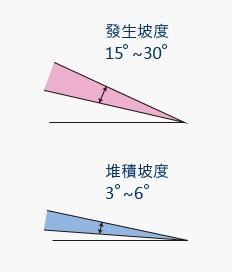
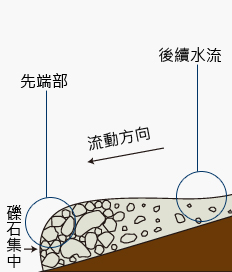
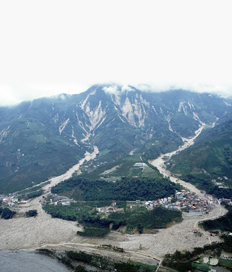
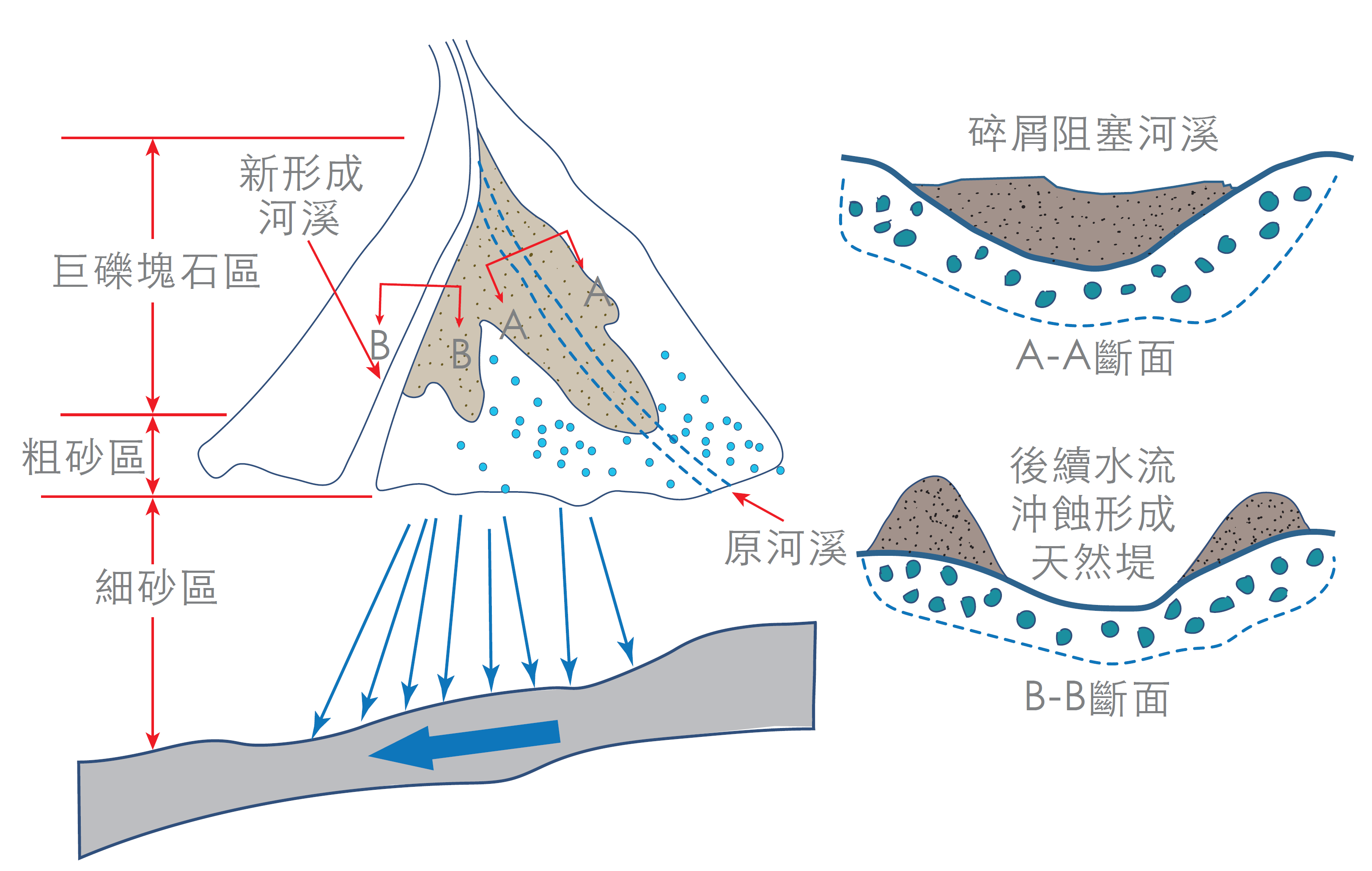
The essential prerequisites for a debris flow include an abundant accumulation of upstream sediment, suitable topography, sufficient slope, and ample moisture. On geologically unstable slopes, large and small rocks, sand, and soil weathered from the mountainside accumulate in valleys or at the foot of slopes due to landslides, mass movements (or landslips), and rockfalls. If these accumulated materials on a steep slope are exposed to heavy rainfall, and the resulting water cannot drain effectively, the mixture of soil, sediment, and water will flow rapidly downhill under gravity, forming a destructivedebris flow with far-reaching consequences.
Abnormal roaring sound from the mountain
Stream water is abnormally turbid
Streamflow decreases abruptly
Odor of humus/decomposed soil
Feeling ground vibration
| Time of Sign Occurrence | Sign / Indicator | Cause | |||
|---|---|---|---|---|---|
| Hours Before | One Hour Before | Minutes Before | Debris Flow Occurs | ||
| 1. Nearby landslide or debris flow occurs (Sight) | Indicates that surrounding slopes and geological conditions are already unstable | ||||
| 2. Sudden increase in torrent flow (Sight) | Heavy rainfall may be occurring upstream | ||||
| 3. Abnormal roaring sound from the mountain (Hearing) | A landslide or debris flow may have already occurred upstream | ||||
| 4. Abrupt decrease in streamflow (Sight) | The upstream channel may be blocked by collapsed sediment | ||||
| 5. Floating driftwood in the stream (Sight) | Landslide or bank erosion may have occurred upstream | ||||
| 6. Abnormally turbid stream water (Sight) | Landslide or bank erosion may have occurred upstream | ||||
| 7. Sound of rocks grinding in the stream (Hearing) | Caused by increased streamflow and transported debris | ||||
| 8. Odor of humus or decomposed soil (Smell) | Uprooted vegetation or exposure of decomposed soil layers upstream | ||||
| 9. Sound of cracking trees (Hearing) | Trees being struck and broken by an upstream debris flow | ||||
| 10. Abnormal animal behavior (Sight) | Animals may react to abnormal natural changes before humans perceive them | ||||
| 11. Feeling ground vibration (Touch / Vibration) | Vibration caused by the rolling and impact of debris flow materials | ||||
| 12. Loud explosive sound and flash of light upstream (Hearing / Sight) | Impact of large boulders during debris flow movement | ||||
| Hours Before | One Hour Before | Minutes Before | Debris Flow Occurs |
Legend: Will Occur ● High Likelihood ● Possible Likelihood ● |
|
| Characteristic | Debris Flow | Sediment-Laden Water Flow |
|---|---|---|
| Transport Mechanism | Bulk transport | Individual particle transport |
| Driving Force | Primarily the sediment mass | Primarily the water body |
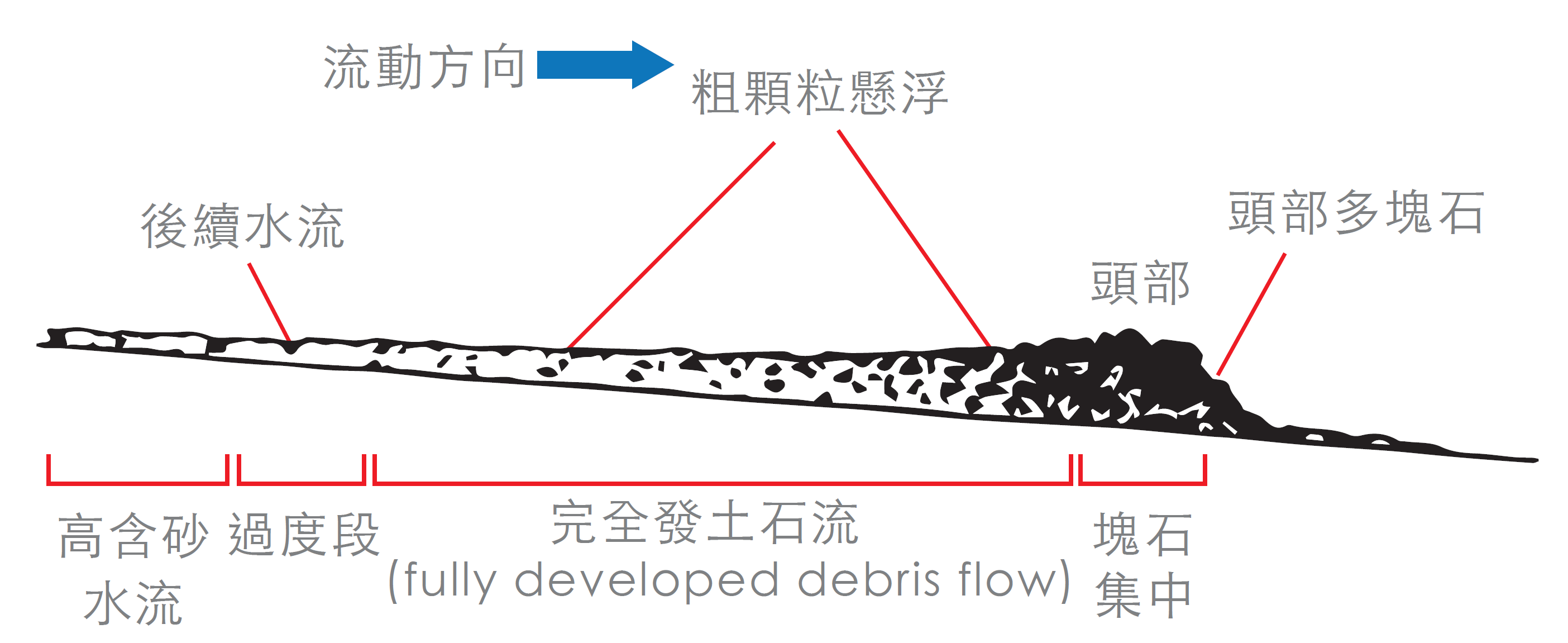
| Boulder Distribution | Large boulders concentrated at the front | No distinct distribution pattern |
| Particle Composition | Wide range of particle sizes, from clay to large boulders/cobbles | More uniform particle size composition |
| Deposition Characteristics | Massive deposition, with coarse particles accumulating at the front | Deposits along the flow direction, exhibiting sorting, with finer particles distributed at the front |
| Sediment Concentration | Volumetric concentration approx. 0.28 or higher | Low volumetric concentration |
| Stream Bed Scour Pattern | Intense scouring of the streambed and both banks, vegetation uprooted | Exhibits general and localized scouring, vegetation remains present |
| Fluid Viscosity | High | Low |
| Movement Pattern | Tends to flow in a straight line, does not flow around obstacles | Depends on circumstances, often flows around obstacles |
| Classification Criterion | Types | Reference |
|---|---|---|
| Geomorphological Conditions | Channel-type debris flow, Hillslope-type debris flow | Soil and Water Conservation Handbook (2017) |
| Sediment/Source Material | Collapse-source debris flow, Dam-break (temporary dam) type debris flow, Channel-bed scour-source debris flow, Landslide-source debris flow, Mixed-type debris flow | Soil and Water Conservation Handbook (2017) |
| Formation Mechanism/Cause | Natural debris flow, Anthropogenic debris flow | Zhan Qian-Deng (2000) |
| Size of Collapse/Source Area | Large-scale collapse-induced type, Head-scarp collapse-induced type, Small-scale collapse-induced type, Channel deposit flow-type debris flow | Nakasu (1977) |
| Sediment Supply/Movement Mechanism | Sliding type, Collapse type, Channel erosion type, Hillslope erosion type debris flow | Zhou Bi-Fan (1980) |
| Triggering Factor | Heavy rainfall type, Snowmelt type, Combined heavy rainfall and snowmelt type, Earthquake-induced type, Volcanic eruption-induced type debris flow | Ikeya (1980) |
| Developmental Stage | Development stage, Active stage, Waning stage, Dormant stage debris flow | Chen Guang-Xi (1983) |
| Predisposing/Initiating Factors | Excited type, Triggered type, Induced type debris flow | Lu Ru-Ren (1988) |
| Occurrence Geomorphology | River Valley type, Mountain Slope type debris flow | Zhou Bi-Fan et al. (1991) |
| Rheological Characteristics | Soil-mechanics type, Hydraulics type debris flow | Zhou Bi-Fan (1991) |
| Dynamic Conditions | Hydraulic-driven, Gravity-driven, Dynamic-driven debris flow | Wu Jian-Min (1991) |
| Occurrence Pattern | Slope collapse liquefaction debris flow, River valley natural dam-break debris flow, Unstable channel-bed deposit debris flow | Takahashi(1991) |
| Particle Composition | Gravel-type debris flow, Mudflow-type debris flow, and Debris Flow (three types) | Soil and Water Conservation Handbook (2017) |

Agency of Rural Development and Soil and Water Conservation(ARDSWC), MOA.
No.6, Guang-Hua Rd., Chung-Hsing New Village, Nantou, Taiwan, R.O.C.
Office hour:Monday to Friday
08:30~12:30, 13:30~17:30