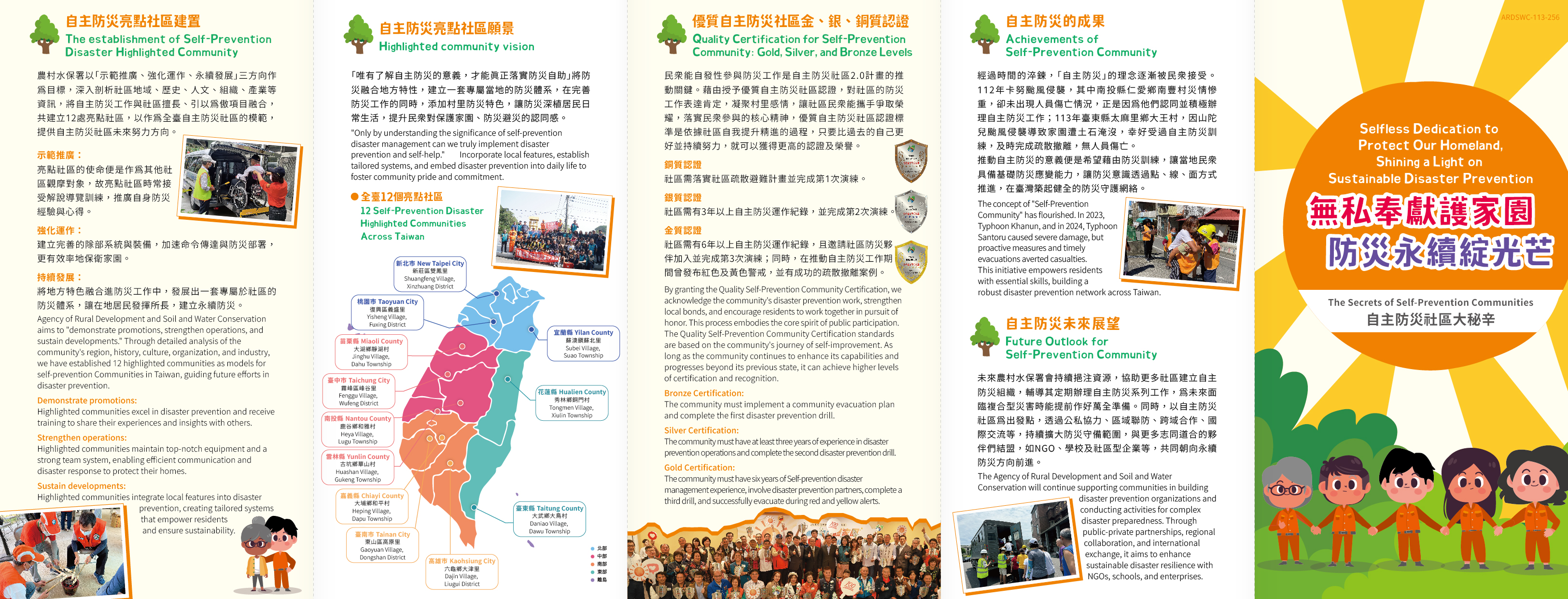
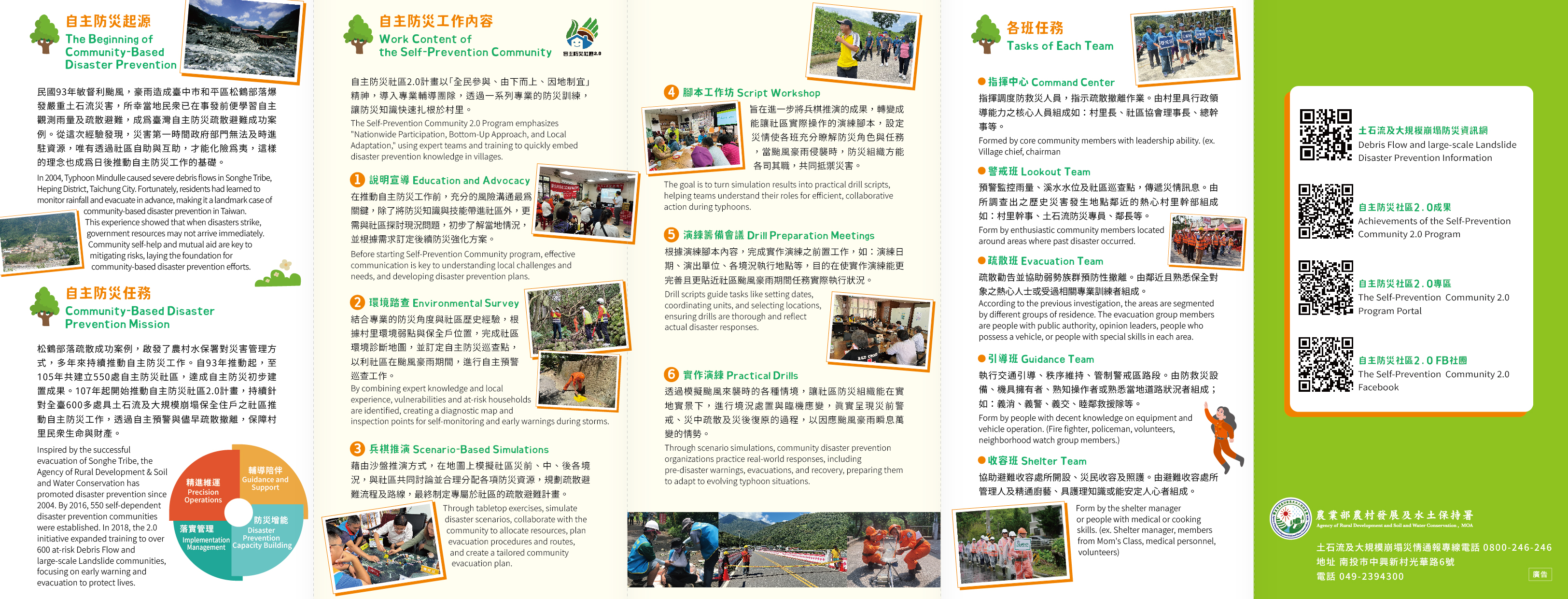
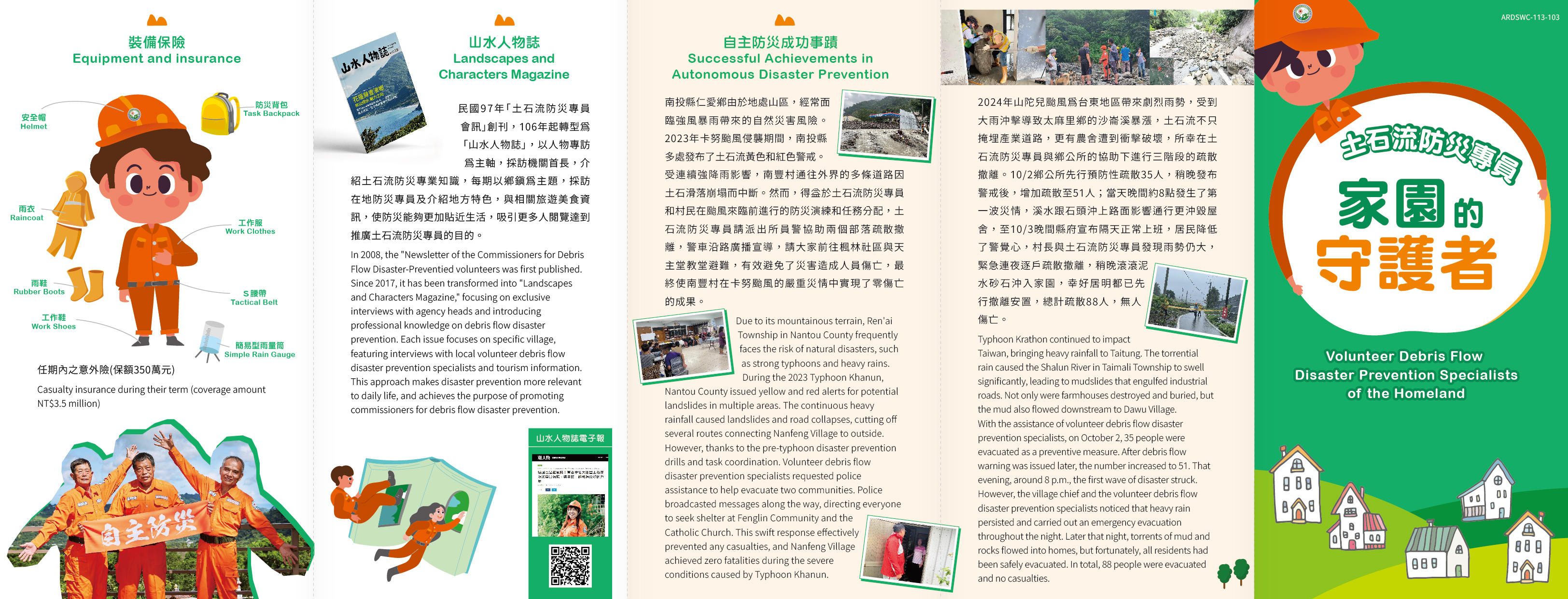
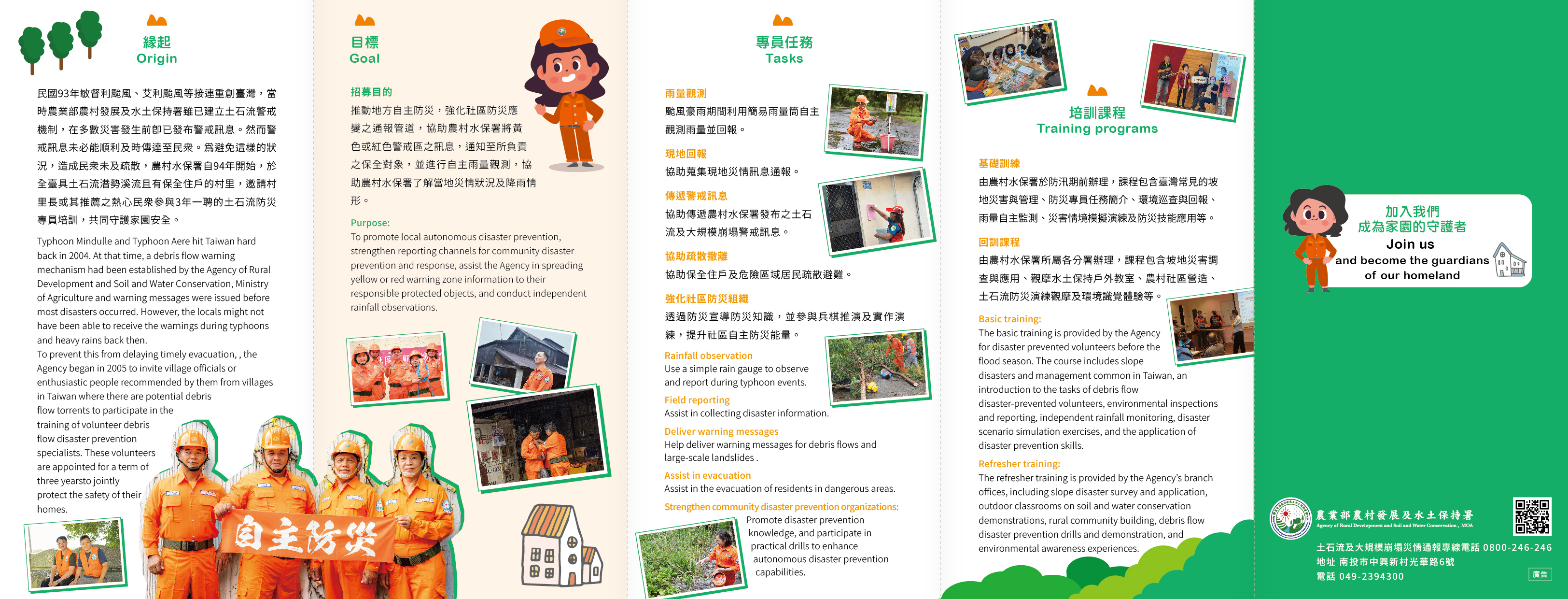
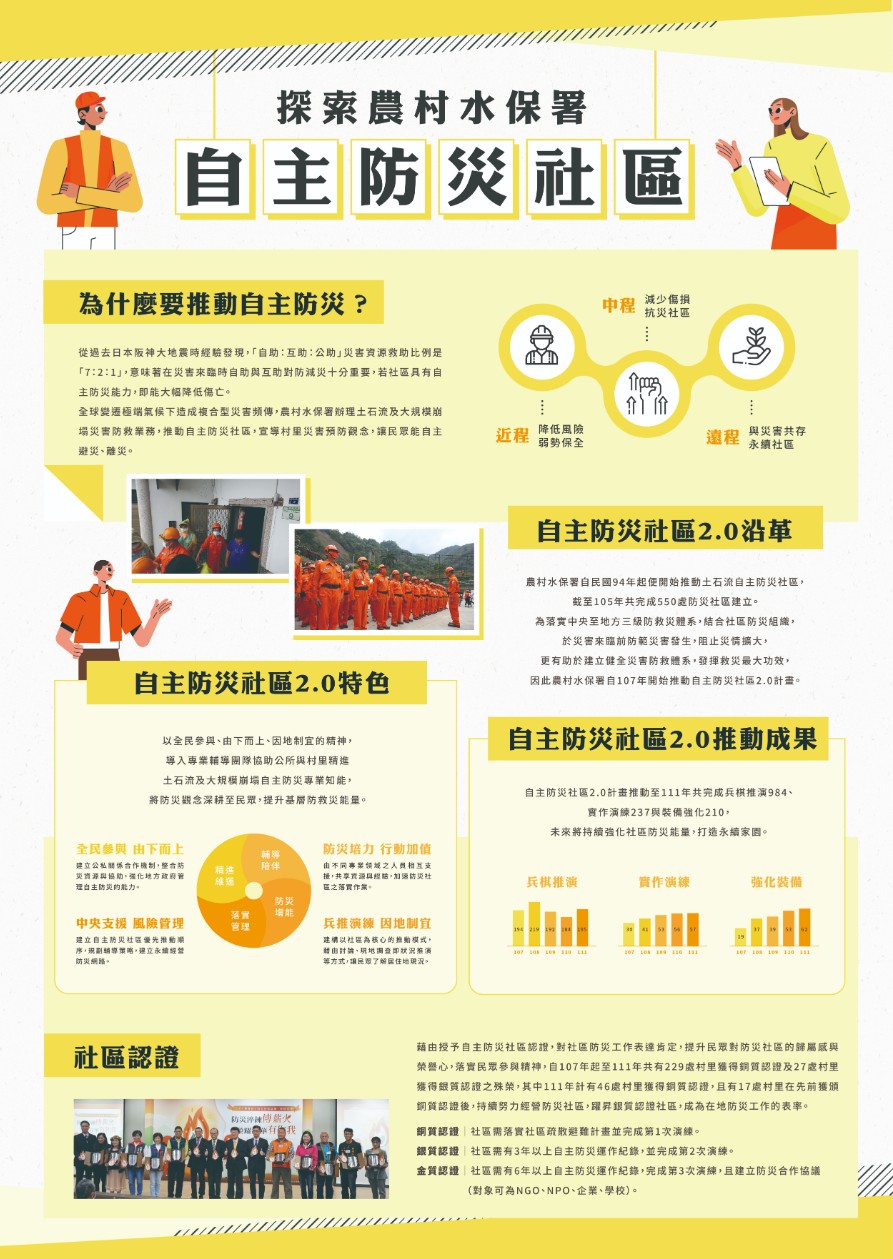
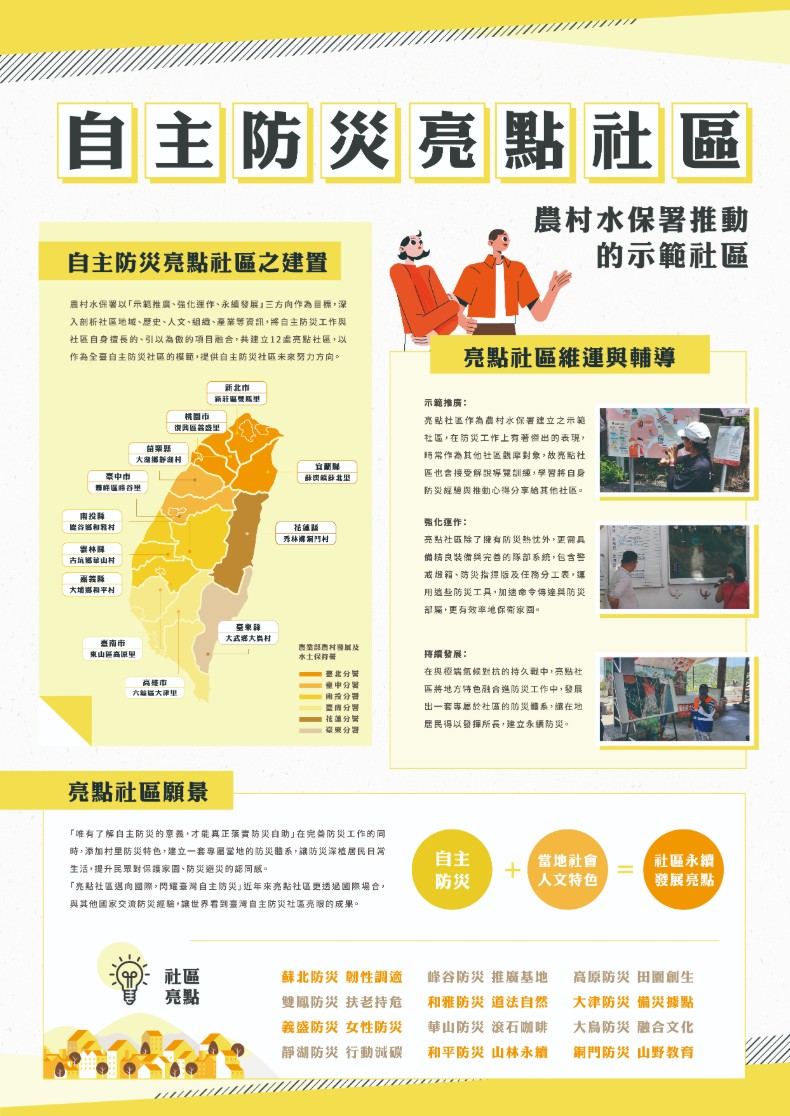
The Soil and Water Conservation Bureau (SWCB) began promoting Debris Flow Self-Initiated Disaster Resilient Communities in the 93rd year of the Republic of China (2004) and upgraded it to the "Self-Initiated Disaster Resilient Community 2.0" in the 107th year of the Republic of China (2018). Through methods such as drill training, tabletop exercises, and disaster prevention publicity, it teaches the public correct knowledge and skills for debris flow disaster prevention and helps them recognize potential risk factors in the environment. This deeply roots the concept of disaster prevention within villages and neighborhoods, making it a key task for effectively enhancing grassroots disaster prevention and relief capacity. The subsequent guidance for local governments to manage and operate the debris flow self-initiated disaster resilient communities will be an important indicator for future local disaster prevention and mitigation work.
Self-Initiated Disaster Preparedness Community Concept Overview
Self-Initiated Disaster Preparedness Community 1.0
The Soil and Water Conservation Bureau (SWCB) integrates existing subsidy programs to continuously assist local governments in systematically and structurally managing self-initiated disaster resilient communities. It introduces support teams to assist in guidance, establishes long-term community partnerships, and adjusts disaster prevention plans and drill content according to community status and needs, serving as a communication bridge between local governments and communities. By implementing the country's three-tier disaster prevention mechanism to ensure the sustainable operation of self-initiated disaster resilient communities, this becomes the core objective of this plan.
Philosophy
Implement Local Government Management of Disaster Resilient Communities:
Self-initiated disaster resilient communities have achieved initial promotion results. In the future, they need to be closely integrated with the disaster prevention and relief system, strengthen the local government's ability to manage self-initiated disaster resilient communities, and establish a sustainable disaster prevention network.
Enhance Self-Initiated Disaster Resilient Community Management:
Considering the differences in environmental risk, socioeconomic, and cultural conditions of communities, different guidance strategies should be formulated for the promotion sequence of self-initiated disaster resilient communities, implemented in a phased manner over different years, and supported by subsequent evaluation or incentive mechanisms.
Introduce Professional Talent from Guidance Teams:
To address disaster-related community affairs from all disaster perspectives, mutual support, resource sharing, or experience exchange among personnel from different professional fields will help accelerate the implementation of disaster resilient communities.
Expansion and Capacity Building of Disaster Prevention Organizations:
In the past, community disaster prevention organizations often lacked funding and manpower, making independent operation difficult. We will seek support from non-governmental organizations and utilize the social networks they have established through local efforts to form alliance-like organizations.
Emphasize Public Participation:
Previous disaster prevention drills mostly focused on the horizontal and vertical integration and coordination among administrative agencies. This plan will change the past approach to drills and promotion by strengthening public participation. Through discussions, on-site investigations, and scenario role-playing, citizens will understand the current status of their residential area and the items requiring public cooperation when the government executes disaster prevention work, thus jointly improving disaster preparedness.
Promotion Strategies
Promotion Sequence for Debris Flow and Large-Scale Landslide Self-Initiated Disaster Resilient Communities
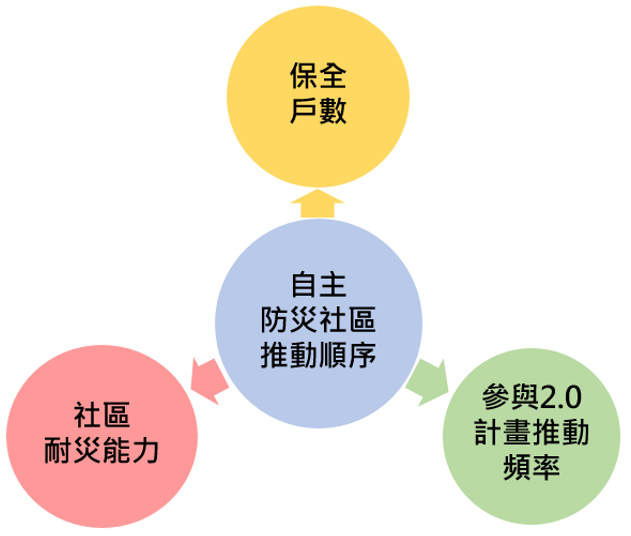
The promotion sequence for self-initiated disaster resilient communities is an important reference indicator for the SWCB's promotion efforts. It is primarily based on a comprehensive assessment of three factors: "Community Resilience," "Number of Protected Households," and "Frequency of Participation in the Community 2.0 Project." The assessment of Community Resilience includes three major indicators: Disaster Impact, Community Organization Operation, and Evacuation and Response Capability, reflecting the community's disaster prevention quality. The number of protected households in the community and the frequency of autonomous disaster prevention tabletop and practical drills are also factors that cannot be ignored. To determine the promotion sequence for self-initiated disaster resilient communities, all three factors must be considered together to promote self-initiated disaster resilient communities more efficiently and systematically.
圖示:自主防災社區推動順序。
This table lists the grading descriptions for the three scoring indicators (Protected Households, 2.0 Project Participation Frequency, Community Resilience), and the promotion sequence level based on the total score of the three items.
Scoring Item
Protected Households
2.0 Project Participation Frequency
Community Resilience
Grading
1: Low Population
3: High Population
1: High Frequency
3: Low Frequency
1: High Resilience
3: Low Resilience
Promotion Sequence
※Total value of the three factors
" 8, 9 " promotion sequence level is Priority;
" 6, 7 " promotion sequence level is Secondary Priority;
" 3, 4, 5 " promotion sequence level is General.
Develop Community Graded Management and Promotion Strategy
Based on the autonomous disaster prevention promotion sequence, villages and neighborhoods with protected households located within the influence range of debris flow potential streams and large-scale landslide potential areas are simplified into three levels. Given the different challenges they face, different disaster prevention strategies are considered and corresponding guidance strategies are provided according to the different levels. This directs resources to communities in need, accumulates community disaster preparedness capacity, and moves towards the goal of sustainable development.
Self-Initiated Disaster Resilient Community Graded Management Promotion Strategy
Priority
Community Status Overview
Of the three indicators—"Number of Protected Households," "Community Resilience," and "Frequency of Participation in Self-Initiated Disaster Resilient Community 2.0 Project"—two are rated as high risk, and the remaining one is medium or high.
Guidance Strategy
Conduct autonomous disaster prevention publicity work to promote disaster prevention concepts and knowledge.
Secondary Priority
Community Status Overview
Two risk ratings are one high and one medium, and the remaining one is medium or low.
Two risk ratings are high, and the remaining one is low.
All three risk ratings are medium.
Guidance Strategy
Invite community leaders and enthusiastic citizens to conduct debris flow disaster prevention tabletop exercises to discuss autonomous disaster prevention strategies.
Establish clear disaster prevention strategies and guide community-based disaster prevention drills to strengthen preparedness through practical operational experience.
General
Community Status Overview
One risk rating is low, and the other one is medium or low.
Two risk ratings are low, and the remaining one is high.
Guidance Strategy
Provide retraining and guidance, refine details of task division, and encourage the sharing and export of disaster prevention experience.
Plan Subsidy Items and Frequency
Based on the risk level determined by the SWCB for each village and neighborhood, this plan integrates existing subsidy resources and is implemented in two phases: Phase I, the Autonomous Disaster Prevention Training and Management Implementation Plan; and Phase II, the Autonomous Disaster Prevention Equipment and Facility Enhancement Implementation Plan, to guide local governments in managing debris flow self-initiated disaster resilient communities and promote relevant work items.
Autonomous Disaster Prevention Implementation Plan
Autonomous Disaster Prevention Training and Management Implementation Plan
Self-Initiated Disaster Resilient Community Tabletop Exercise
Target Audience: Members of Autonomous Disaster Prevention Organizations
Tabletop Exercise Workshop
Review of Disaster Prevention Work
Self-Initiated Disaster Resilient Community Practical Drill
Target Audience: Members of Autonomous Disaster Prevention Organizations and Community Residents
Education and Training
Field Drill
Establishment of Self-Initiated Disaster Resilient Community Support System
Target Audience: Local Government Disaster Prevention Personnel and Community Cadres
Enhance local government disaster prevention and relief capacity
Establish operational support to provide professional disaster prevention consultation to communities and demonstrate promotion results
Autonomous Disaster Prevention Equipment and Facility Enhancement Implementation Plan
Self-Initiated Disaster Resilient Community Equipment Enhancement
Target Audience: Procurement of necessary equipment and gear for the operation of self-initiated disaster resilient communities
Thorough review of community needs before procurement
Priority given to communities conducting practical drills in the current year
Based on the autonomous disaster resilient community promotion sequence established by the SWCB, which is divided into three levels—Priority, Secondary Priority, and General—different subsidy plan approval frequencies are utilized to encourage high-risk communities to actively promote autonomous disaster prevention publicity and drills, and to ensure that communities classified as Secondary Priority and General can steadily enhance or maintain existing achievements. The subsidy application frequency is as follows:
Self-Initiated Disaster Resilient Community Plan Approval Frequency
Priority
Plan Approval Frequency
Self-Initiated Disaster Resilient Community Tabletop Exercise: Can be applied for annually
Self-Initiated Disaster Resilient Community Practical Drill: Can be applied for once every 3 years
Secondary Priority
Plan Approval Frequency
Self-Initiated Disaster Resilient Community Tabletop Exercise: Can be applied for every 2 years
Self-Initiated Disaster Resilient Community Practical Drill: Can be applied for once every 3 years (Applicable starting from Minguo 112/2023)
General
Plan Approval Frequency
Self-Initiated Disaster Resilient Community Tabletop Exercise: Can be applied for every 2 years
Self-Initiated Disaster Resilient Community Practical Drill: Can be applied for once every 4 years
Reminders/Notes
Villages and neighborhoods with a higher promotion sequence rank receive priority subsidy. (Note: If 'Secondary Priority' and 'General' both apply simultaneously, the 'Secondary Priority' village/neighborhood receives priority funding.)
The subsidy amount for the 'Establishment of Self-Initiated Disaster Resilient Community Support System' is approved based on the total number of communities conducting tabletop exercises and practical drills.
The location for the 'Autonomous Disaster Prevention Equipment and Facility Enhancement Implementation Plan' should be primarily the site of the Phase I practical drill in the current year.
Self-Initiated Disaster Resilient Community 2.0 Emblem
The concept of autonomous disaster prevention mainly originated from the 1995 Kobe Earthquake in Japan, which caused massive devastation. Post-disaster investigation revealed that over 70% of rescue operations were completed before government agencies arrived, with the ratio of "Self-Help : Mutual-Aid : Public-Aid" being approximately 7:2:1. In light of this, the Agency of Rural Development and Soil and Water Conservation (ARDSWC) of the Ministry of Agriculture began promoting self-initiated disaster resilient communities in the 93rd year of the Republic of China (2004), deeply rooting the concept of autonomous disaster prevention in villages and neighborhoods. This strengthens citizens' willingness to participate in disaster prevention work, helps local areas implement autonomous management for debris flow prevention, and establishes a bottom-up disaster prevention mechanism. Through public participation, the transmission of disaster information and evacuation/relocation work also become more efficient. During Typhoon Morakot, many lives were saved due to the community residents' effective evacuation and shelter management, demonstrating that the "community" is not only the most fundamental but also the most important link in the disaster prevention and relief system! To make self-initiated disaster resilient communities more robust and strong, the core objective of 'Self-Initiated Disaster Resilient Community 2.0' is to integrate willing community members into disaster prevention organizations, enhance two-way communication, devise response strategies and organizational divisions based on community needs and disaster characteristics, conduct field drills, and continuously revise debris flow evacuation and shelter plans, allowing the self-initiated disaster resilient communities to operate sustainably. The Self-Initiated Disaster Resilient Community 2.0 certification emblem is intended to galvanize public participation in disaster prevention and enhance community residents' sense of belonging and honor regarding the promotion of self-initiated disaster resilient communities.
Illustration: Self-Initiated Disaster Resilient Community 2.0 LOGO.
Subsidized Funding and Application Method
Subsidized Funding
Phase I: Autonomous Disaster Prevention Training and Management Implementation Plan
Self-Initiated Disaster Resilient Community Tabletop Exercise: The budget allocated for this item (including SWCB subsidy and local government matching funds) is capped at NT$50,000 per session.
Self-Initiated Disaster Resilient Community Practical Drill: The budget allocated for this item (including SWCB subsidy and local government matching funds) is capped at NT$300,000 per session.
Establishment of Self-Initiated Disaster Resilient Community Support System: The budget allocated for this item (including SWCB subsidy and local government matching funds) is subsidized based on the total number of villages/neighborhoods approved in the county/city for 'Self-Initiated Disaster Resilient Community Tabletop Exercise' and 'Self-Initiated Disaster Resilient Community Practical Drill' in the current year. Maximum subsidy is NT$900,000 for 1-5 approved villages, NT$1,000,000 for 6-10, NT$1,100,000 for 11-15, NT$1,200,000 for 16-20, NT$1,300,000 for 21-25, NT$1,400,000 for 26-30, and NT$1,500,000 for 31 or more.
All Special Municipality and County/City Governments should duly consider the situation, accurately budget the total project funding, and determine the allocation of current expenditure items for county/city matching funds or increase self-raised funds based on their fiscal condition to strengthen the overall promotion effectiveness. The actual subsidy amount will be adjusted and approved by the SWCB based on the current year's funding status.
Phase II: Autonomous Disaster Prevention Equipment and Facility Enhancement Implementation Plan
Self-Initiated Disaster Prevention Equipment and Facility Enhancement: The budget allocated for this item (including SWCB subsidy and local government matching funds) is capped at NT$150,000 per location.
All Special Municipality and County/City Governments should duly consider the situation, accurately budget the total project funding, and determine the allocation of current and capital expenditure items for county/city matching funds or increase self-raised funds based on their fiscal condition to strengthen the overall promotion effectiveness. The actual subsidy amount will be adjusted and approved by the SWCB based on the current year's funding status.
The "Ministry of Agriculture, Agency of Rural Development and Soil and Water Conservation's Self-Initiated Disaster Resilient Community 2.0 Promotion Program" is applied for in two phases. Phase I is the application for the "Autonomous Disaster Prevention Training and Management Implementation Plan," which includes the work items: "Self-Initiated Disaster Resilient Community Tabletop Exercise," "Self-Initiated Disaster Resilient Community Practical Drill," and "Establishment of Self-Initiated Disaster Resilient Community Support System." The three aforementioned work items can be applied for based on actual needs, but the "Establishment of Self-Initiated Disaster Resilient Community Support System" must be executed in conjunction with either the "Self-Initiated Disaster Resilient Community Tabletop Exercise" or the "Self-Initiated Disaster Resilient Community Practical Drill." Phase II, the "Community Autonomous Disaster Prevention Equipment and Facility Enhancement Implementation Plan," is submitted based on the investigation results of the "Self-Initiated Disaster Resilient Community Practical Drill" in Phase I. Details are as follows:
Phase I: Autonomous Disaster Prevention Training and Management Implementation Plan
Application Schedule and Method:
The Special Municipality and County/City Governments should submit the villages/neighborhoods for subsidy application to the Debris Flow Disaster Preparedness Management System between November 1 and mid-November of the year preceding the plan's execution (the applied villages/neighborhoods can be selected by referring to the aforementioned debris flow self-initiated disaster resilient community promotion sequence).
After the Agency convenes the first Disaster Preparedness Meeting to decide on the number of sessions to be executed, the Special Municipality and County/City Governments shall revise the plan content according to the meeting resolution and officially submit the "Autonomous Disaster Prevention Training and Management Implementation Plan" Description to the Agency for compilation before the end of December of the year preceding the plan's execution. The Agency will issue the official approval letter before early January of the plan's execution year. Submissions of the aforementioned implementation plan description that are overdue, incomplete, or do not comply with regulations may not be accepted by the Agency.
Application Documents: Autonomous Disaster Prevention Training and Management Implementation Plan Description
Phase II: Autonomous Disaster Prevention Equipment and Facility Enhancement Implementation Plan
Application Schedule and Method:
The application should be officially submitted to the Agency between November 1 and December 15 of the year preceding the plan's execution (the applied villages/neighborhoods are limited to those that applied for the "Self-Initiated Disaster Resilient Community Practical Drill" in Phase I), and the Special Municipality and County/City Governments must fill out the application details for the subsidized villages/neighborhoods in the Debris Flow Disaster Preparedness Management System.
After the Agency convenes the first Disaster Preparedness Meeting to decide on the number of sessions to be executed before the end of January of the plan's execution year, the plan content should be filled out in the Debris Flow Disaster Preparedness Management System before the end of June of the plan's execution year, in conjunction with the investigation and execution results of the "Self-Initiated Disaster Resilient Community Practical Drill" in Phase I. The Special Municipality and County/City Governments must then officially submit the "Autonomous Disaster Prevention Equipment and Facility Enhancement Implementation Plan" Description to the Agency for approval. Submissions that are overdue, incomplete, or do not comply with regulations may not be accepted by the Agency.