
Top Navigation Bar

@*土石流及大規模崩塌防災資訊網logo圖片*@ Debris Flow and Large-Scale Landslide Disaster Prevention Information Network logo image @*土石流及大規模崩塌防災資訊網名稱圖片*@ Debris Flow and Large-Scale Landslide Disaster Prevention Information Network name image
Debris Flow and Large-Scale Landslide Disaster Prevention Information Network

自主防災

·

培訓土石流防災專員

Training Debris Flow Disaster Prevention Specialists
Origin

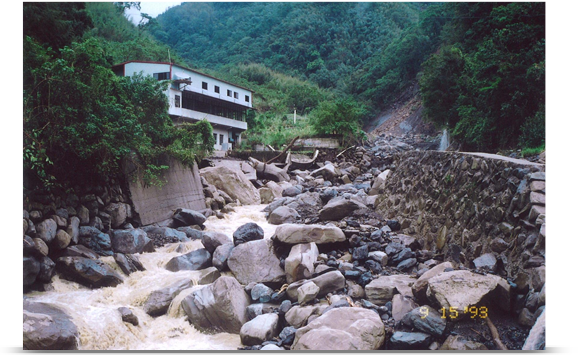
[cite_start]                        Typhoons Mindulle (7/2 Flood Disaster), Aere, and Haima successively devastated Taiwan's mountainous areas in 2004, causing numerous sediment-related disasters such as debris flows[cite: 392, 393]. At the time, although the Agency of Rural Development and Soil and Water Conservation, Ministry of Agriculture (formerly Council of Agriculture), had established a debris flow warning mechanism and issued warnings before most disasters occurred. However, due to frequent interruptions of roads, transportation, power, and communication equipment in mountainous areas during typhoons and torrential rains, these warning messages could not always be smoothly and promptly delivered to the public. [cite_start]To prevent such situations, which could result in residents failing to evacuate in time, and to strengthen the self-disaster prevention capabilities of residents and communities, the Agency of Rural Development and Soil and Water Conservation, Ministry of Agriculture, began training Debris Flow Disaster Prevention Specialists (Volunteers) in 2005. They invited village/community chiefs or enthusiastic residents recommended by them from 613 villages/communities across Taiwan that have potential debris flow torrents [cite: 392] and households requiring protection. After training, they are provided with formal equipment and insurance.

Objectives of the Formation
To assist in debris flow disaster prevention and education work, enabling the public to gain a deeper and more accurate understanding of debris flow disaster prevention concepts and relevant knowledge, thereby achieving the goals of disaster prevention, reduction, and avoidance.
To promote local self-disaster prevention, strengthen community disaster response reporting channels, assist the Agency of Rural Development and Soil and Water Conservation, Ministry of Agriculture, in notifying the households requiring protection under their responsibility about Yellow or Red Warning Area messages, and conduct independent rainfall observation to help the Agency understand the local disaster situation and rainfall conditions.
Specialist's Duties
Independent Rainfall Observation Station Monitoring
  • Use a rain gauge to observe rainfall value and send the rainfall data via SMS.
  • Actively report and evacuate when the observed rainfall reaches the warning threshold.
Disaster Information Reporting
  • Assist in reporting on-site disaster conditions back to the Agency or its regional offices.
  • On-site photos can be sent via email.
Warning Message Dissemination
  • Inform local residents of Debris Flow Red and Yellow Warning Messages.
  • Report local evacuation status back to the Agency or its regional offices.
Assisting with Evacuation and Shelter
  • Assist local governments in evacuating protected households.
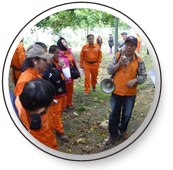
  • Participate in debris flow disaster drills and promotion activities during normal times.
Strengthening Community
Disaster Prevention Organizations
  • Find partners to protect the homeland.
  • Conduct scenario simulation exercises to enhance the community's self-disaster prevention capability.
[Rights]

Provided by the Agency of Rural Development and Soil and Water Conservation, Ministry of Agriculture
  1. Relevant training courses and activities
  2. Personal equipment for Debris Flow Disaster Prevention Specialists
  3. Accident insurance during the term of office (coverage of 3.5 million NTD)
  4. Others: such as promotional materials, etc.
Rights and Obligations
Term of Office
3-year term (renewable)
[Obligations]
  1. On-site rainfall observation and data reporting, and disaster situation reporting
  2. Dissemination of Yellow or Red Warning disaster prevention messages
  3. Assist in debris flow disaster prevention work such as promotion and drills
  4. Participate in annual recurrent training
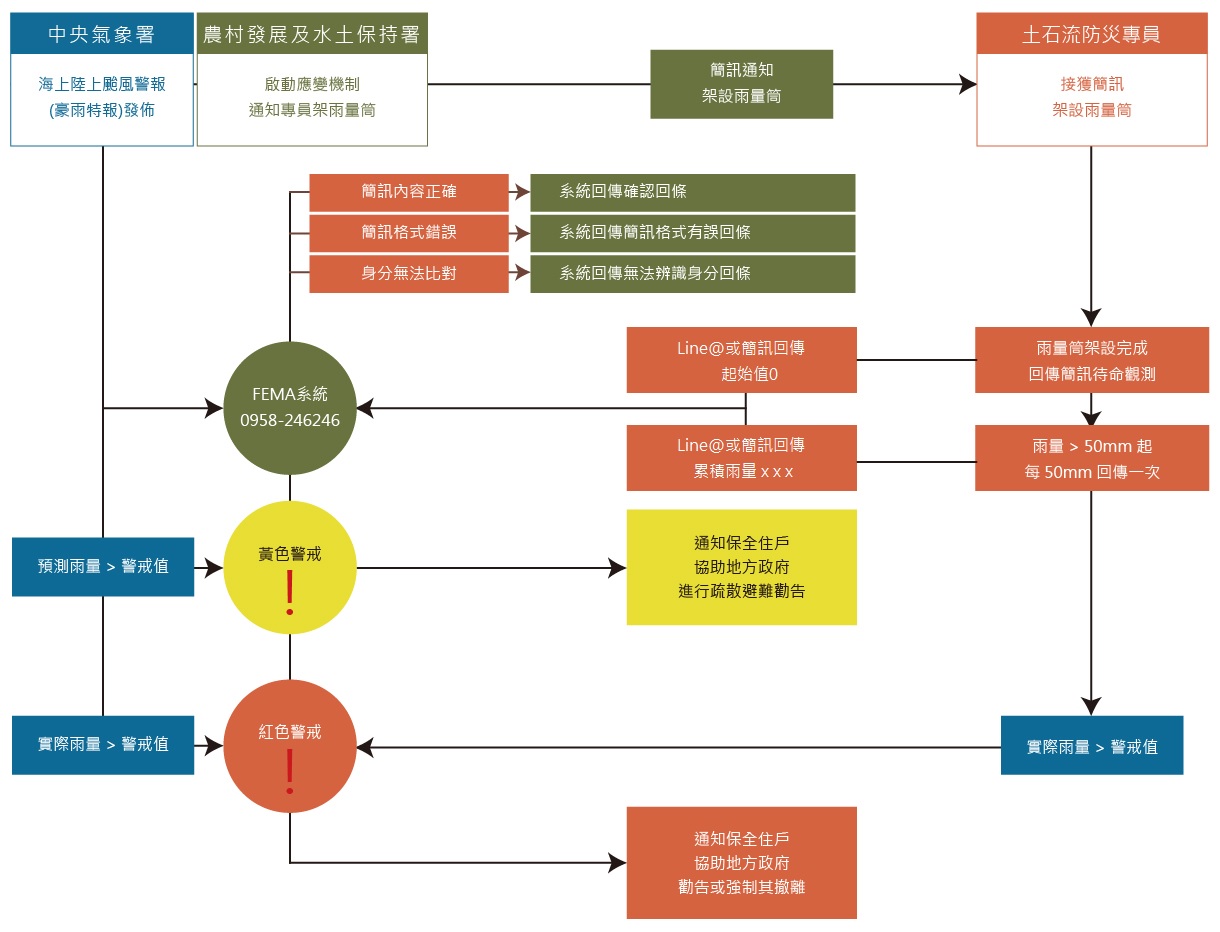
Debris Flow Disaster Prevention Specialist Operating Procedure
Diagram: Debris Flow Disaster Prevention Specialist Operating Procedure.
Specialist Training
Basic Training: Includes introduction to the specialist's duties, on-site information reporting, and rainfall data interpretation.
Recurrent Training Courses: Observation of Soil and Water Conservation Outdoor Classrooms, rural community development, observation of debris flow disaster drills, etc.
Equipment for Debris Flow Disaster Prevention Specialists

Portable and professional personal disaster prevention equipment is the basic gear for Debris Flow Disaster Prevention Specialists to protect their homes.
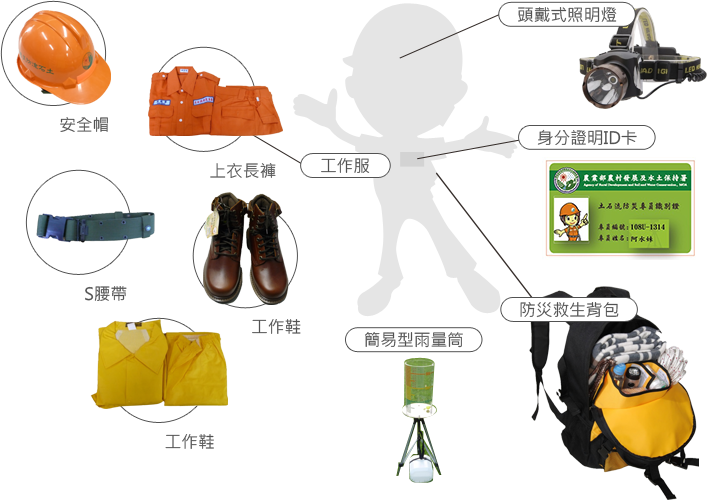
Specialist Equipment
Diagram: Specialist Equipment.
Disaster Prevention Tool - Introduction to the Disaster Prevention Backpack
Disaster Prevention Backpack Introduction

Backpack Size
60cm x 40cm x 30cm

Creativity
Practicality
Recommendation

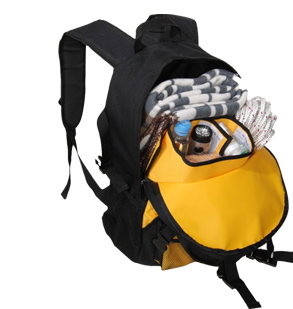
Multi-pocket waterproof design to prevent items in the backpack from getting wet. The bottom, front compartment, and sides of the backpack can all be used to store other items. The back strap is equipped with an adjustable waist buckle to keep it securely in place.

Debris Flow Disaster Prevention Specialists bear the mission of providing frontline assistance for disaster prevention, disaster situation reporting, and rainfall observation. Therefore, the reporting and disaster prevention equipment for the specialists must consider the practicality and safety in special working environments and emergency response, serving functions such as safety, identification, and internal use. Without adequate disaster prevention equipment, they will not be able to smoothly carry out disaster rescue and relief work, or may even miss the golden time for reporting.

As the saying goes, "A craftsman must first sharpen his tools if he is to do his work well," emphasizing that carrying professional personal disaster prevention equipment is essential gear for Debris Flow Disaster Prevention Specialists to traverse mountains and streams and protect the soil and water. The complete set of equipment produced by the Agency of Rural Development and Soil and Water Conservation, Ministry of Agriculture, for the specialists is described below, focusing on the contents of the disaster prevention backpack:

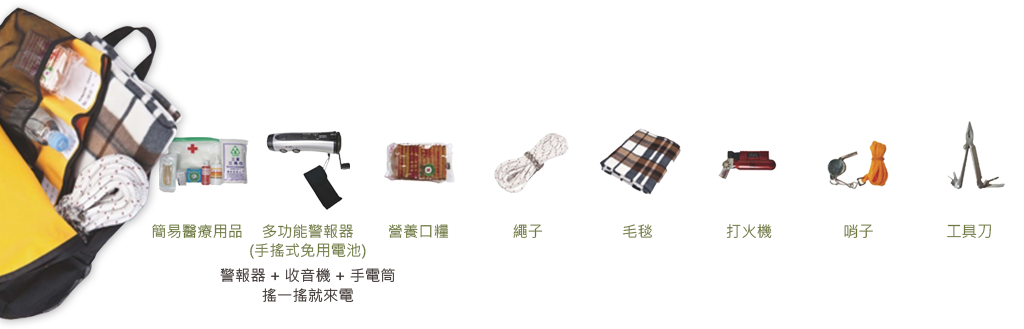
The disaster prevention backpack is the basic disaster prevention equipment for Debris Flow Disaster Prevention Specialists, including the backpack (with storage bag), rope, multi-function alarm, rations, simple medical supplies, utility knife, whistle, and lighter. Its features are durability and portability. A storage bag is also provided for convenient organization of the contents, which can be neatly placed and marked with the expiration date of the items, reminding the specialist to use or replace them before the deadline.

Place it by the door at home
In an escape, a person's first reaction is to run towards the main door. Placing the disaster prevention backpack by the door or escape route avoids wasting time rummaging. It is best to check and replace the contents once a month. Crucially, do not stuff all your belongings into the rescue bag, as an overweight bag may hinder your escape opportunity.
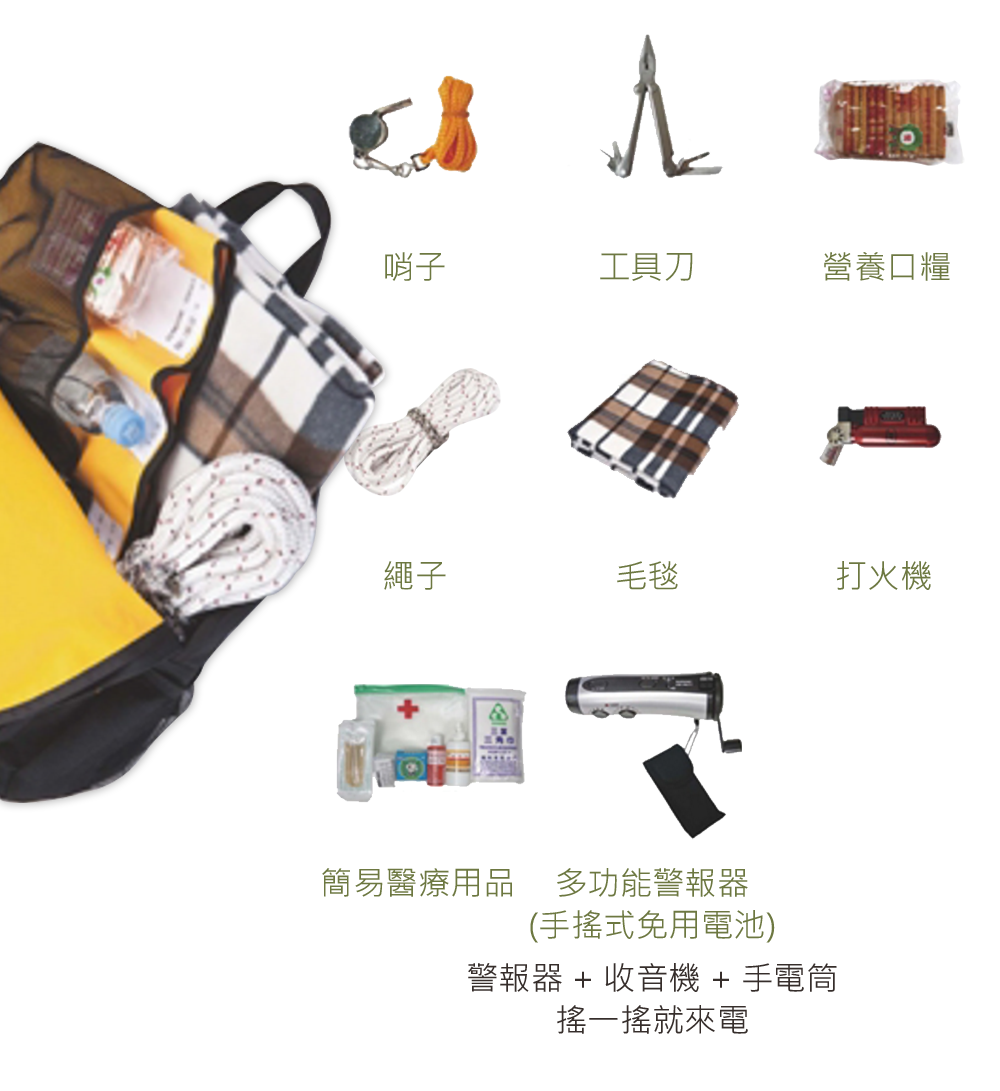
Disaster Prevention Backpack Contents
Diagram: Disaster Prevention Backpack Contents.
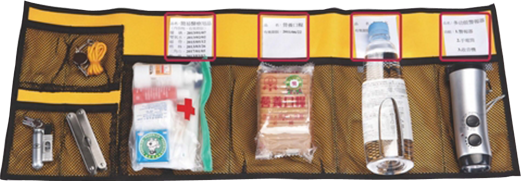
Internal Storage Bag for the Backpack
Ultra-functional storage compartments for organizing various tools and first aid supplies. Items can be clearly and neatly organized according to their size and shape. An expiration date label is also included to remind the specialist to use or replace the items before the deadline.
Successful Evacuation Cases
98 Typhoon Morakot Disaster (2009)
  • Typhoon Morakot in 2009 caused major disaster in southern Taiwan. The Debris Flow Disaster Prevention Specialists trained by the Agency of Rural Development and Soil and Water Conservation, Ministry of Agriculture, independently observed rainfall during the typhoon, timely assisted residents to evacuate to shelters, and proactively reported disaster and evacuation status across various locations. In total, 9,100 residents were successfully evacuated during this disaster, potentially preventing 1,046 casualties.
99 Typhoon Megi (2010)
  • During Typhoon Megi in 2010, multiple landslides occurred in Yongle Village. Rainwater carried collapsed soil and rocks, causing mudflows to invade residential homes. A slope behind the Yongle Activity Center in Neighborhood 1 collapsed, and sediment/mudflow buried the activity center and Fude Temple, with an accumulation depth of up to 50 cm. Due to the immediate evacuation of 30 local residents to relatives' homes by Debris Flow Disaster Prevention Specialist and Village Chief Yu An-Bin, there were no casualties.
99 Typhoon Megi (2010)
  • During Typhoon Megi in 2010, heavy rainfall caused multiple landslides in Shenghu Village. Collapsed soil and rocks buried several roads and places like Nanshun Temple. The heavy rainfall also caused floods to invade residential homes, with inundation heights reaching 50 cm. Fortunately, Debris Flow Disaster Prevention Specialist Zhang Xiu-Feng evacuated about 30 people to the activity center early, resulting in no casualties.
99 Typhoon Fanapi (2010)
  • During Typhoon Fanapi in 2010, Debris Flow Disaster Prevention Specialist and Village Chief Hong Jia-Ming of Laiyi Village, Laiyi Township, Pingtung County, began soft persuasion to evacuate on the afternoon of the 18th. Approximately 400 villagers voluntarily descended the mountain to stay with relatives or seek shelter at the evacuation center at the base of the mountain. On the 19th, debris flows during Typhoon Fanapi damaged 50 houses. However, due to effective evacuation and sheltering, there were no casualties.
104 Typhoon Soudelor (2015)
  • During Typhoon Soudelor in 2015, residents of Luofu Village, Fuxing District, Taoyuan City, began voluntary evacuation on August 7th, with 25 people relocating. On August 8th, debris flows damaged 15 houses. However, due to the effective evacuation and sheltering organized by the District Chief, Village Chief Wang Guo-Zhi, and Debris Flow Disaster Prevention Specialists Liao Guo-Da and Yang Tai-Ying, there were no casualties.

Disaster Prevention Specialist Journal

Total Records
頁面頂端

分享與工具列